



Study outline
Use these points to guide a group study or personal review. The full discussion and supporting sources follow below.
- The controversy among Christians: Consider useful applications, concerns about truth and responsibility, selected church leaders’ views, and the lesson of Gemini’s inaccurate historical images.
- How language models work: Understand next-token prediction, training, and tuning—and why confident wording does not establish truth or personal belief.
- Using AI as a study tool: Find possible Bible references, investigate Hebrew and Greek words, and locate source material that can be checked.
- A focused research exercise: Summarize Hugh Ross’s treatment of Genesis 6 in The Genesis Question, using the book and clearly identified supporting sources, including Reasons to Believe.
- Keeping truth and interpretation distinct: Verify quotations, references, editions, and page numbers; distinguish Scripture from an author’s interpretation and the AI’s summary.
- Putting the process into practice: Use the sample prompt, open the sources, and bring the findings back to Scripture and responsible Christian study.
Christians and AI: A Useful Tool, Not a Source of Truth

A Christian approach to AI: church leaders’ views, the Gemini image controversy, how language models generate answers, practical study uses, and a reusable prompt that separates Scripture, interpretation, and scholarly opinion.
Artificial intelligence has given Christians something new to argue about—and something useful to learn how to use. It can find possible Bible references, organize research, compare arguments, and explain unfamiliar vocabulary in seconds. It can also invent a quotation, blend incompatible interpretations, or present a confident answer that does not survive a careful reading of its sources.
Those possibilities call for discernment. We do not need to treat every new tool as a threat, and we should not give a tool authority simply because it writes well. AI can assist our study. It should not become our source of spiritual truth.
The practical question is how to use it without handing over the work of reading, checking, thinking, praying, and learning alongside other Christians.
Bible study with technology kept in its place

1. Why Christians disagree about AI
Some concerns are about truth: whose assumptions shape the answers, which theological traditions get represented fairly, and whether citations are real. Others concern honesty and responsibility. Is a pastor presenting machine-written work as personal study? Is a user confusing a sympathetic response with genuine pastoral care? Does convenience encourage us to stop wrestling with a difficult passage?
The useful side is easy to see, too. A tool that helps locate material, organize notes, or prepare questions can reduce busywork and make a subject more approachable. These uses do not all raise the same issues as outsourcing a sermon or asking a chatbot to settle a matter of conscience.
John Piper draws a firm distinction between research assistance and replacing a preacher’s own work. In his February 24, 2025 discussion, he permits using AI for information and inspiration, insists on giving credit for generated composition, and strongly objects to having it produce a sermon’s first draft. His concern includes honesty and the pastor’s responsibility to understand and teach Scripture. Read Piper’s full response.
Pope Leo XIV, writing to an AI ethics conference on June 17, 2025, recognizes potential benefits while arguing that the technology must serve human dignity and development. He distinguishes extensive access to data from wisdom and emphasizes the intellectual and spiritual development of young people. Read his message.
These leaders speak from different Christian traditions and are addressing different aspects of the problem. Neither statement should be treated as a survey of all Christians. Together, however, they raise a useful test: does the tool support responsible human work, or encourage us to surrender it?
The Gemini example: a polished image can still be wrong
Reported outputs included men of color as Founding Fathers, a Black woman as a Viking, and an Asian woman as pope. The Washington Post covered the controversy.
Not every viral accusation proves a historical error; a particular depiction needs to be evaluated against the requested person, office, and period. But Google itself acknowledged that Gemini’s people-image feature had produced inaccurate results.
In its February 23, 2024 explanation, Google said the feature used Imagen 2 and had been tuned to generate a range of people. That tuning did not properly account for historical or other situations requiring a specific depiction. The system also became too cautious about some harmless requests. Google paused people-image generation while working on corrections. Google’s explanation of what went wrong.
This was an image-generation failure, not a complete explanation of how a text model works. It nevertheless illustrates an important point for Christian users: an AI product’s output reflects human decisions about training, tuning, and behavior. A convincing presentation is not a certificate of accuracy. That matters when the subject is a historical portrait, and it matters when the subject is a Bible passage.
2. How a language model builds an answer
A large language model processes text in small pieces called tokens. A token might be a word, part of a word, or punctuation. When a typical generative language model writes an answer, it uses the conversation so far to estimate which token should come next, selects one, adds it, and repeats. Google’s introduction explains tokens and language prediction.
For a simple illustration, consider the beginning of a sentence: “She opened the book and began to …” The word “read” would fit naturally. A modern model does something vastly more complex than finishing that one sentence: its learned patterns can connect ideas across a long passage and support explanations, translations, and problem-solving. But the act of generating plausible language does not automatically establish whether a statement is true.
During pretraining, the model learns patterns from large collections of material by adjusting its internal numerical parameters. It can acquire useful language skills and information, along with errors and biases present in the material. Later training can improve how it follows instructions and performs particular tasks. More on model tuning.
Examples of desired answers and feedback about better or worse responses can also shape an assistant’s behavior. Anthropic, for example, describes both human and AI feedback in its account of post-training. The exact recipe varies between systems. See the model training description in its system card.
Fluency is not verification—or a confession of faith
Instructions, the wording of a question, and any documents supplied in the conversation can further influence the response. An application may also give the model search tools or access to a document collection. Those tools can provide evidence, but the resulting answer still needs to represent that evidence accurately.
A chatbot can produce a convincing paragraph from a Catholic, Reformed, Wesleyan, or skeptical perspective. The ability to express a position does not show that the system personally believes it. Likewise, an answer beginning with “I believe” is not evidence of personal faith, spiritual discernment, or pastoral responsibility.
Confident wording is also a poor measure of factual reliability. A model may combine a real author, a plausible book title, and an invented page number into something that looks scholarly. Repeating the question and receiving the same answer is not independent confirmation. Asking another chatbot can help expose a disagreement, but it does not replace opening the source.
The useful habit is to treat a generated answer as a lead to investigate. Give the most weight to evidence you can actually inspect.
3. Useful ways to bring AI into Bible study
Start with locating, not settling. If you remember a passage only approximately, ask for possible references and the reason each might match. Then open those passages in a Bible. A concordance or a search of a specified translation remains better suited to an exact, exhaustive word count than an unverified chatbot answer.
For example: “Suggest passages that discuss hospitality, identify the translation you use, and distinguish exact wording from passages related by theme.” That is a useful starting list. It is not permission to publish every suggested reference without reading it.
Use language questions to guide further study. AI can help frame questions about a Hebrew or Greek word: its dictionary form, grammatical form in a verse, possible senses, and why translations differ. Ask which lexicon or scholarly commentary supports each claim. Then consult that entry and check how a qualified scholar handles the word in context.
A dictionary’s list of possible meanings does not mean that every meaning applies in every occurrence. Nor does identifying a word’s roots automatically establish what a biblical author meant. A useful request is: “Which senses are plausible in this sentence, what grammatical evidence matters, and where do interpreters disagree?”
Compare material you can see. Supplying two short excerpts and asking for their agreements and differences can be more useful than requesting a sweeping account of everything an author has ever said. Require the answer to identify what is in the excerpts and what would need additional research.
A focused example: Hugh Ross on Genesis 6 in The Genesis Question
Suppose I want to understand what Hugh Ross says about Genesis chapter 6 in his book The Genesis Question. This is a specific research task: summarize his treatment of that chapter and find sources that help explain it, starting with his ministry’s website, Reasons to Believe. A survey of competing interpretations can come later.
The listed contents of the expanded second edition identify sections on long life spans, the sons of God and the Nephilim, and the boundaries of God’s wrath. Those topics give the research a useful structure. Here is an initial, source-based guide to Ross’s treatment and related explanations:
- Life spans and the restraint of evil. In his own essay “Why Shorter Life Spans?”, Ross reads Genesis 6:3 as God purposefully shortening human life. He connects that action with the wickedness described in the chapter: long lives could help civilization develop, but could also allow evil people to do harm for centuries. In his reading, shorter lives express mercy by limiting evil’s spread. This is Ross’s interpretation, supported here by his website essay.
- The sons of God and the Nephilim. A later Reasons to Believe article by Hugh Henry and Daniel J. Dyke, “Who Are the ‘Men of Renown’ in Genesis 6?”, reports Ross’s proposal that human involvement with fallen angels or demons affected human genes. That is a useful lead for locating and checking his argument in the book. The article is by other authors; their description should not be presented as a quotation from Ross’s book.
- Judgment and the coming Flood. Ken Mansfield’s review of The Genesis Question describes Ross’s discussion of God’s character and judgment in Genesis 6–9. It reports his view that the Flood’s judgment encompassed humanity without requiring water to cover the entire planet. The review is critical of Ross, so it should be identified as a secondary account and checked against the book, rather than treated as Ross speaking for himself.
These online sources establish the research topics and supply explanations to investigate. They do not substitute for reading the relevant book passages. Exact wording and page references still need to be checked in the edition being used. A later Ross book, Navigating Genesis, should not silently be substituted for The Genesis Question.
A focused request could be:
Summarize Hugh Ross’s treatment of Genesis chapter 6 in The Genesis Question. Focus on his explanation of the chapter, including life spans, the sons of God and the Nephilim, and God’s judgment. Identify the edition and which book passages you can actually access. Find supporting discussions, especially on Reasons to Believe. For each point, distinguish the book itself, Ross’s own related writing, and another author’s summary. Provide source links. Do not invent quotations or page numbers; state what still needs checking in my copy. Keep comparisons with other interpretations as an optional follow-up.
The first goal is to understand and represent Ross accurately. Once that work is done, looking at other viewpoints can be a useful next step. Throughout the process, keep the words of Genesis, Ross’s interpretation, and the AI’s summary clearly separate.
4. Change the question—and check the evidence
Instead of stopping at “What does this passage mean?”, try “What interpretations do Christian scholars offer, and what sources support them?” The second question makes room for evidence, context, and disagreement. It also makes the answer easier to check.
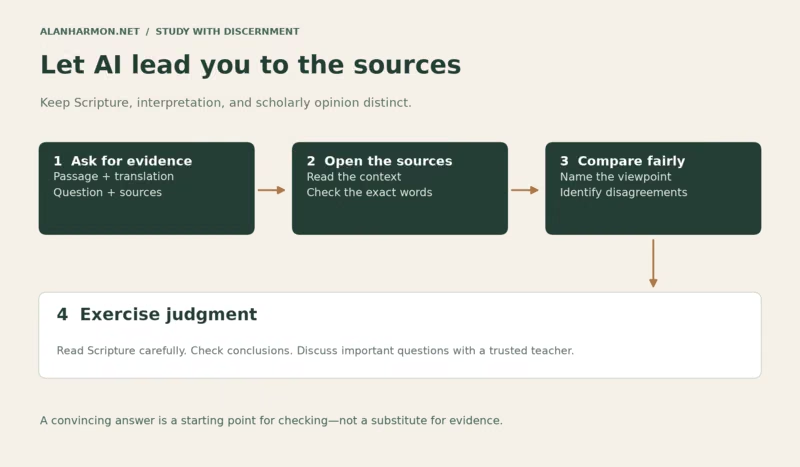
A practical review takes only a few deliberate steps:
- Read the passage. Identify the translation and read the surrounding paragraphs, not just the isolated verse.
- Open the cited source. Confirm that the author and work exist and that the link leads to the claimed material.
- Check the wording. A paraphrase must not be presented as a direct quotation. Read enough context to see whether the summary is fair.
- Check the location. Verify the book edition, publication details, and page number against that edition. Different formats and editions may paginate differently.
- Separate the levels of claim. Distinguish the biblical text from an interpretation, a scholar’s argument, and the AI’s own synthesis.
- Bring important questions to people. Discuss contested teaching or a significant personal application with a trusted pastor, teacher, or mature Christian who can engage with both the text and your circumstances.
A citation is useful only if it actually supports the statement beside it. Five links to loosely related pages do not make an unsupported claim reliable.
Let AI lead you to the sources
A sample prompt you can reuse
Help me research [passage or question]. Use [Bible translation] for the biblical text. Work as a research assistant, and do not present your answer as spiritual authority.
Separate the response into: (1) Scripture and immediate context; (2) major Christian interpretations, naming the relevant traditions or scholars; and (3) scholarly opinion, unresolved questions, and your own tentative synthesis.
For each interpretation, explain the argument and provide sources that actually support it. Prefer the author’s original work. Distinguish quotations from paraphrases, and identify the translation for any quoted Scripture.
Verify quotations and references against sources you can access. For books, identify the edition and give a page number only if you have checked that edition. If you cannot inspect a source, label it as unverified and do not invent its wording or location.
For Hebrew or Greek claims, identify the word and its form in this passage, explain the relevant context, and name the lexicon or scholarly source being used. Do not imply that every possible dictionary meaning applies here.
State where scholars disagree, what evidence would help resolve the question, and what I should read or discuss with a qualified teacher next.
This prompt improves the assignment; it does not guarantee a reliable answer. The reader still has to carry out the checks.
Keep the tool in its proper place
Christian study has room for useful technology. Searchable texts, dictionaries, commentaries, and research assistants can all help us ask better questions. AI adds speed and flexibility, along with a particular temptation to mistake a smooth explanation for a settled answer.
Use it to gather leads, organize comparisons, explain terminology, and expose questions you might otherwise miss. Let it help you reach the sources. Then read those sources, evaluate the argument, and remain accountable for what you believe and teach.
For the Christian reader, Scripture deserves careful attention that a generated summary cannot replace. A tool can assist that attention. It should not become the authority that decides what is true.
Prepared with AI assistance from Alan’s outline. The cited views belong to the named authors; the study examples and sample prompt are practical suggestions. The lead image is an AI-generated illustration, and the workflow diagram is explanatory.