



A Huge Step for Commercial AI Agents: Grok Bot and Muse

A September 2026 look at Grok Bot and Meta Muse: release dates, cloud computers, practical capabilities, early adoption estimates, and the difference between downloading an agent and trusting it with useful work.
AI is moving into a more practical phase. The question is becoming: can I give it a job, go do something else, and come back to useful work?
The recent releases of Grok Bot and Meta’s Muse make that question much more concrete. Both put an agent inside a computer environment where it can use tools and carry work forward. The interesting change is the product surrounding the AI: persistent work, connected accounts, memory, and a way to supervise the result.
That combination looks like a huge step for commercial AI agents. Here is what has actually been announced, what the early adoption numbers show, and why the next stage will be measured in completed jobs. This article reflects information available on September 24, 2026; it is a look at the releases, rather than a hands-on review of either product.
Grok Bot: a team of agents you can hand work to
Grok Bot launched in beta on August 11, 2026. The announcement on x.ai, now branded SpaceXAI, describes agents that work in a cloud computer, use apps and websites, remember context, and continue while the user is away. You can message them from desktop or iOS and return to the same conversation later. Read the launch announcement.
The team concept is central. Rather than putting every assignment into one conversation, a user can create specialists for research, inbox work, operations, or other responsibilities. Bots can exchange context and coordinate in group chats. The company also describes teaching an agent a routine by having it follow an existing process, then refining it through corrections.
The appeal is easy to understand: a business has many small jobs that cross several systems. A useful agent has to connect those steps and leave its work where the business already operates.
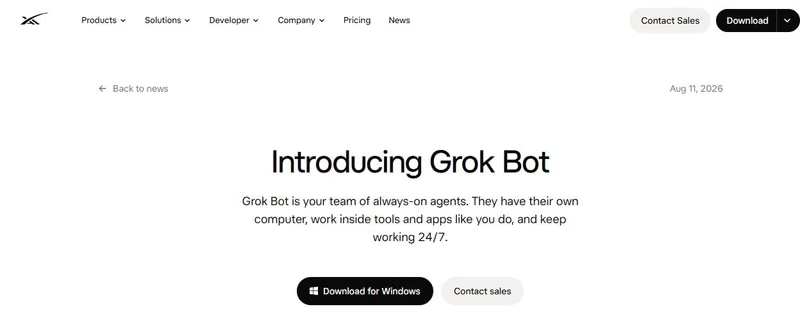
What Grok Bot can do—and how access expanded
The August 26 expansion brought Grok Bot to all SuperGrok, Cursor Pro, and Cursor Teams plans, including the higher tiers listed in the announcement. Bot usage is separate from ordinary Grok and Cursor usage. That is a subscription entitlement, not a promise of unlimited work.
Examples in that release include researching sales prospects and preparing outreach for approval; sorting an inbox; reviewing files and subscriptions; handling support requests under a company’s policy; and building and deploying a website. Its cloud computer includes a browser and terminal, so its work can extend beyond services with a convenient integration.
Enterprise availability followed on September 3. That release added access, network, and audit controls. The company’s examples span recruiting shortlists, marketing follow-ups, vendor spending reviews, and monitoring software changes for problems. It also said thousands of organizations had adopted Grok Bot, naming Legora, Supermicro, and ServiceTitan. That is a vendor-reported adoption claim, rather than an independently audited count of paying customers. Enterprise release details.
The two-week enterprise promotion announced then was a launch offer. Readers should check current terms rather than assume that September 3 offer is still active.
Muse: Meta brings the personal agent to everyday life
Meta introduced Muse on September 8, 2026. Its emphasis is personal tasks and longer-term goals: tell it what you want to accomplish, and it helps make a plan and move the work forward. Meta says it is powered by Muse Spark; Muse is the agent product, while Muse Spark is the model powering it. Meta’s launch announcement.
Muse has its own dedicated cloud computer, called Muse Secure VM. It can browse websites, fill out forms, and continue working after the app closes. Meta’s examples include arranging travel, lowering a bill, and organizing a shopping task. It returns when something changes or requires a decision, with approval before sensitive actions such as sending an email or making a purchase.
The familiar messaging approach matters. People can communicate through the Muse app or WhatsApp. Its current website also describes access on mobile and Mac. That gives this category a route to people who would never set up a coding environment or assemble an automation themselves.
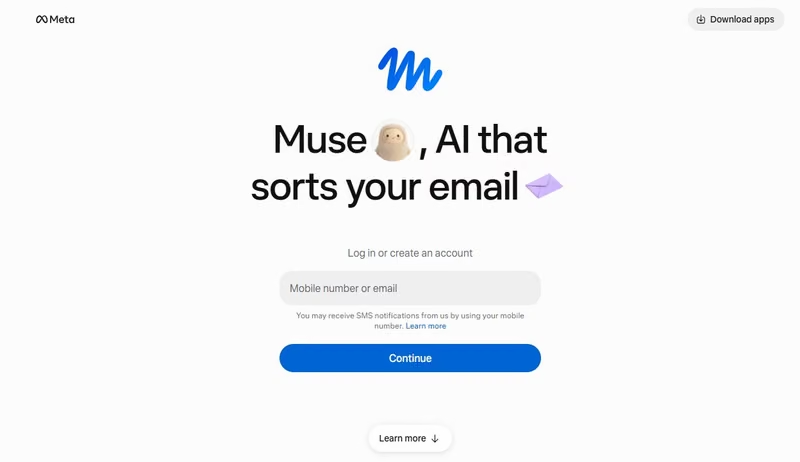
Muse can produce something useful, too
Meta’s product design account goes beyond the shopping examples. Muse can create documents, PDFs, web pages, and interactive outputs. The team describes spending trackers, study guides, and dashboards. Its computer includes a file system and terminal, allowing it to write code and create tools for a task.
It can also manage background work on a schedule or in response to relevant events. Goals, activity history, and editable memory help users see what is underway. These details matter because a useful ongoing assistant needs more than a long chat transcript: it needs a record of the job, the next step, and the decisions already made.
Consider a possible household workflow: gather deadlines from connected messages, organize them into a short action list, prepare the necessary documents, and ask before submitting anything. This is an illustrative use case, not a claim that I have tested that complete sequence in Muse. The value would come from reducing the small handoffs that otherwise consume a morning.
The downloads arrived quickly
Early interest is substantial. Appfigures’ September analysis provides useful estimates for both products:
- Muse: approximately 1.1 million downloads through September 18, almost entirely in the United States and mostly from Apple’s App Store.
- Grok Bot: roughly one million downloads by September 19, alongside nearly $1 million in estimated net mobile revenue.
- Muse’s chart position: No. 1 on the U.S. App Store on September 19, followed by Google Play on September 20.
These are third-party estimates, not audited company disclosures. They also cover different periods: Grok Bot launched in August, while Muse launched in September. A download is neither a unique retained customer nor proof that someone delegated a successful task.
Still, a new kind of application reaching this scale within its opening weeks deserves attention. The next question is whether people keep using it after the curiosity wears off. A million installations can introduce a category; repeated useful work is what can establish it.
What makes this a bigger step than another chatbot release?
The commercial opportunity is the whole sequence of work. A customer inquiry might require reading an email, locating an order, checking a policy, preparing a response, and updating the right record. A report might require finding several files, reconciling names and totals, producing a readable summary, and saving it where someone will use it.
A good answer is helpful inside those sequences. An agent that can carry several steps through changes how much human coordination the job requires.
| Product emphasis | Grok Bot | Muse |
|---|---|---|
| How the release presents it | Specialized AI teammates for delegated work | A personal agent for tasks and goals |
| Work environment | Cloud computer and existing business tools | Dedicated Muse Secure VM and connected apps |
| Visible organizing idea | Several Bots coordinating responsibilities | A continuing personal relationship with goals and memory |
| What to evaluate | Reliable handoffs and completed business work | Useful follow-through on everyday tasks |
These are differences in emphasis, not rigid boundaries or a benchmark ranking. Both products reach beyond conversation. The diagram below shows the general workflow I would use to judge this category; it is not a specification of either product’s internal architecture.
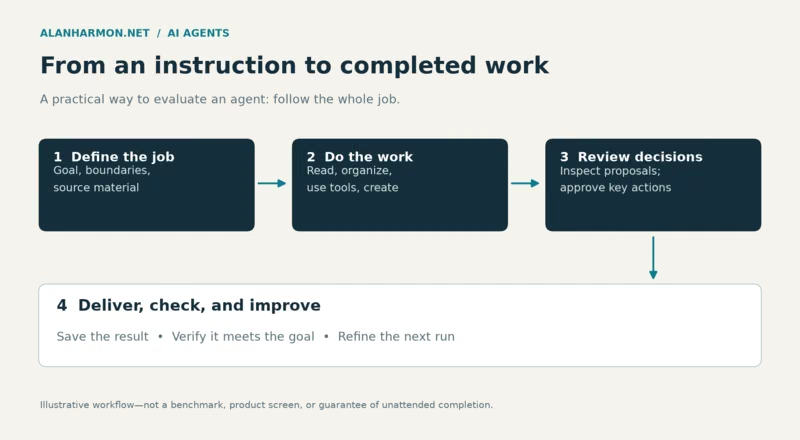
More autonomy makes permissions part of the product
Once software can act through your accounts, the approval process becomes part of its usefulness. Meta’s technical safety explanation describes an isolated agent environment, protected credential storage, and a separate Sentinel that governs connector actions and network access. It also acknowledges that Muse can still make mistakes.
Those are design claims worth understanding, not a guarantee that every task will succeed. A reasonable first assignment is bounded and easy to inspect: prepare a report, organize a set of information, or draft a response. Expand responsibility when the results justify it.
The release timing matters here, too. Meta described a stronger Confidential VM option as coming later in the year. It should not be mistaken for a protection already included in the original September launch. Website access, account permissions, and product availability can also limit what an agent can finish.
The real milestone will be useful work repeated
What makes these releases significant is that persistent agents are becoming recognizable consumer and business products. The user sees an app, a conversation, a job to delegate, and a result to review. Much of the technical setup moves behind that experience.
There is plenty left to prove: accuracy over long assignments, sensible interruptions, manageable cost, and enough transparency to correct a mistake. Early chart success cannot answer those questions.
But the direction is compelling. If these products can reliably take a recurring task from instruction to finished output, they could save far more time than another improvement in conversational fluency. Grok Bot and Muse make that possibility much easier to picture—and their early adoption suggests a lot of people are ready to try it.
Source note: Release capabilities above come from the linked official announcements and product documentation. Download and revenue figures are Appfigures estimates with their stated measurement dates. Screenshots show public websites captured September 24, 2026; capabilities and availability may change.