



Blog Overview
I started blogging again in July 2023 after some shifting of my job responsibilities, and my children growing up which gave me a lot more discretionary time. I do this for me, but I hope some others find my posts interesting or useful in some way.Epstein - Did Trump Just Get Overrun, Or Did He Just Fool Almost Everyone?
11/19/2025 by Alan

Post Content, Images & Videos
Trump's Political Theater
As Senator Kennedy recently said in an interview: “Watch what politicians do, not what they say.” In this piece, we’re going to walk through a hypothetical scenario about Trump, the Epstein files, and Washington’s love of political theater. First, we’ll lay out the theory. Then we’ll follow the chain of events step by step.
Let's Assume There Is Damning Evidence Against Trump’s Enemies
Go with me here—even if you don’t believe it for a second. I’m not sure I do either. But imagine there is extremely damaging information in the Epstein files involving very powerful people: former presidents, top corporate billionaires, and major political figures across the spectrum.
If Trump came out personally and released this evidence, he would immediately be accused of fabricating or manipulating it just to smear his enemies. The media that already hates Trump would frame the story as “Trump’s political hit job” rather than seriously examining whether the evidence is true. The focus would be on Trump as the villain, not on the alleged wrongdoing itself.
What Could Trump Do To Release the Evidence Without Being Blamed?
So what could Trump do if he wanted the information to come out, but did not want to be blamed for it? He could quietly change course from his original promise on the campaign trail to “release all the files.” Instead of pushing for transparency, he could:
- Minimize the importance of releasing the files.
- Delay, stall, or ignore efforts to make them public.
- Send signals behind the scenes that this is not a priority.
- Let allies know there is a bigger game being played.
What would this accomplish? How would Democrats react to such a position? The predictable response would be: “He must be hiding something.”
The Democrats Take the Bait!
From this point, the script almost writes itself. Democrats, activists, and commentators begin to accuse Trump of covering up the truth. They insist that he is protecting his “friends” or hiding his own involvement. The story shifts to:
- “What is Trump hiding?”
- “Why won’t he release the files?”
- “What is in those documents that he doesn’t want us to see?”
In other words, Trump appears to be on the side of secrecy—inviting his opponents to demand transparency.
Pressure Begins from the Democrats To Release the Files
As the narrative builds, pressure grows from the Democratic side to force the release of the files:
- Members of Congress start talking about legislation or resolutions to make the files public.
- Media outlets run segments demanding answers and framing this as a “right to know” issue.
- Activist groups and commentators push the theme of “no one is above the law.”
At this stage, Democrats are publicly owning the position that the Epstein files must be released. They frame it as a moral crusade for transparency and justice.
The Ruse Is Complete – The President Flips
Once the demand for transparency is loud enough and clearly associated with Democrats, the President can suddenly “change his mind.” He can step to the microphone and say something like:
“I’ve heard the concerns. While I had reservations before, I now agree with my colleagues that the American people deserve to know the truth. I will support the release of the files.”
In one move, Trump appears:
- Reasonable and responsive to bipartisan pressure.
- Supportive of transparency.
- Willing to stand with Democrats on this issue.
And most importantly: he is no longer the one pushing this from the beginning. The push came from his opponents.
The President Agrees to Release the Files, Encourages Republicans to Support and Sign the Bill
At that point, Trump can actively urge Republicans to join in:
“I encourage my fellow Republicans to support this measure. If there is nothing to hide, we have nothing to fear from the truth.”
Now, Republicans aren’t just reluctantly going along; they’re being invited to stand for “truth and transparency.” Democrats are already all-in. To vote against releasing the files now would look suspicious on either side.
The Senate and the House Almost Unanimously Vote to Release the Files
Under this kind of framing, a bill to release the files could pass with overwhelming bipartisan support:
- Democrats vote for it to prove they are fighting corruption and holding Trump’s circle accountable.
- Republicans vote for it to back their President and to show they “have nothing to hide.”
The end result: Congress as a whole owns the decision. The release of the files is now a bipartisan act, not a solo move by Trump.
The Fallout: Everyone Owns the Consequences
If the files are truly as explosive as assumed in this hypothetical, the fallout would not land on one party alone. It could implicate people across the political spectrum, in government, business, and culture.
But here’s the key point: When the dust settles, Trump can say:
“I didn’t force this on anyone. You demanded transparency. Congress voted. We all agreed the truth should come out.”
Democrats can’t easily blame Trump alone for the damage, because they were publicly leading the charge to release the files. Republicans can’t claim they were tricked, because they voted for it too. The decision is shared.
Final Thoughts – Watch What They Do, Not What They Say
Is this exactly what is happening? We don’t know. This is a thought experiment, not a claim of fact. But it illustrates an important idea:
- Politics is often theater.
- Public fights can sometimes hide private agreements.
- The loudest “demands” and “resistance” can be part of a script.
Whether you like Trump, hate him, or feel stuck somewhere in between, it’s worth remembering that in politics, motives are rarely obvious—and almost never as simple as the slogans. Watch the actions. Watch who benefits. And always ask: “Who wrote this script—and why?”
Here is a Test I Wrote Back on July 10, 2025
I think this all began back in July, when Trump appeared to do an about face on the Eptein Files, which just didn't smell right. It was odd... and several people agreed that there was a lot happening here that wasn't obvious to most people because they just trust the surface, and don't see what is happening behind the scenes.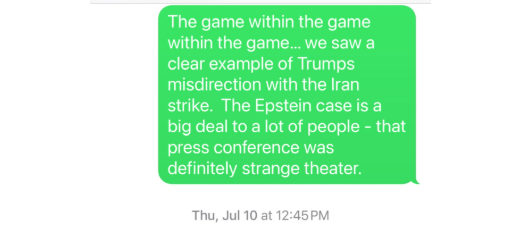
Post Metadata
- Post Number: 333
- Year: 2025
- Slug: epstein-did-trump-just-get-overrun-or-did-he-just-fool-almost-everyone
- Author: Alan
- Categories: Politics & Government
- Subcategories: Jeffrey Epstein
- Tags: trump, epstein-files, political-strategy, political-theater, congress, democrats, republicans, transparency, washington-dc, political-analysis, deep-politics, media-narratives
- Keywords:
- Language Code: en
- Status: published
- Show On Homepage:
- Date Created: 11/19/2025
- Last Edited: 11/19/2025
- Date To Show: 11/19/2025
- Last Updated: 2025-11-19 18:16:46
- Views: 0
- Likes: 0
- Dislikes: 0
- Comments: 0